
 Posted by
 For years, IT organizations have been structured around projects, temporary efforts with fixed timelines, budgets, and hand-offs. But here’s the problem: innovation doesn’t stop when a project closes. Customer needs evolve, technology shifts, and competitive pressures intensify. The most forward-thinking organizations have realized that sustainable innovation requires a fundamentally different approach: the Product Operating Model (POM) powered by agile principles.
This isn’t just a structural change, it’s a mindset shift that transforms how teams work, how value flows, and how innovation becomes continuous rather than episodic.
What Makes a Product Operating Model Different?
The traditional project model treats software and services as outputs delivered to a finish line. The Product Operating Model treats them as living assets that need continuous investment, improvement, and evolution.
In a product model:
- Teams are persistent, not assembled and disbanded per project
- Funding is continuous, allocated to products rather than projects
- Ownership is clear, with product managers accountable for outcomes, not just delivery
- Success metrics focus on business value and user outcomes, not just on-time, on-budget completion
- Innovation is built into the rhythm, not bolted on as separate initiatives
When Netflix transitioned from DVD rentals to streaming, they didn’t run a series of projects. They built persistent product teams that continuously evolved the streaming platform, the recommendation engine, and the content delivery network. Each team owned specific product capabilities and had the mandate to innovate within their domain.
Agile as the Engine of Product Innovation
Agile methodologies and the Product Operating Model are natural partners. While agile provides the framework for iterative delivery and continuous improvement, the product model provides the organizational structure and funding stability that lets agile truly flourish.
Here’s how they work together:
Continuous Discovery and Delivery
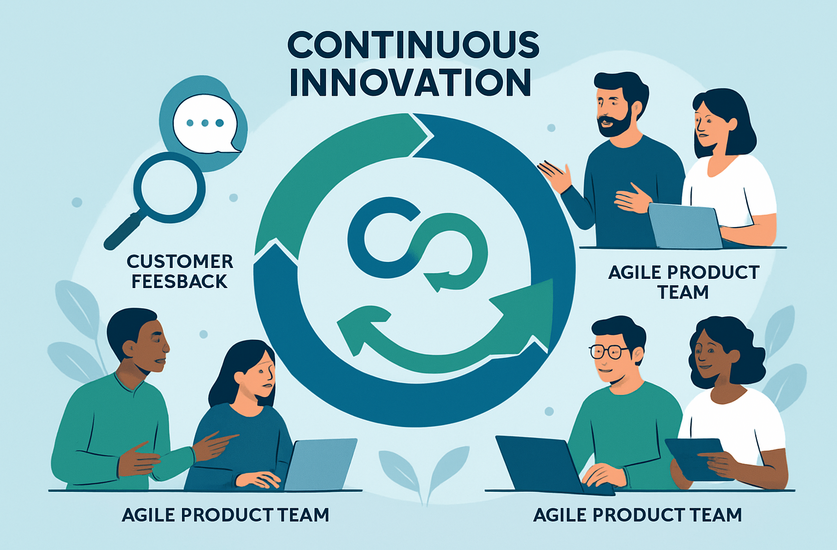
Agile product teams don’t wait for annual planning cycles to identify opportunities. They run continuous discovery, talking to users, analyzing data, experimenting with prototypes. This tight feedback loop enables teams to spot innovation opportunities early and act on them quickly.
Spotify’s squad model exemplifies this approach. Each squad owns a specific part of the user experience, playlists, search, social sharing, and continuously experiments with new features. They don’t need approval for every idea; they have autonomy within their product domain.
Empowered Teams Make Better Decisions
In project-based organizations, innovation often requires multiple approval layers and business case justifications. By the time an idea gets approved, the market may have moved on.
Product teams operate with bounded autonomy. They understand their mission, their success metrics, and their constraints. Within those boundaries, they can experiment, fail fast, learn, and pivot. This speed of decision-making is where innovation thrives.
Consider how Amazon’s two-pizza teams operate. Small, autonomous teams own specific products or services and can innovate rapidly without coordinating across massive organizational hierarchies. This model enabled innovations like Amazon Prime, AWS Lambda, and countless customer-facing features.
Value Streams Over Handoffs
Traditional project models create hand-off points, from business analysts to developers to testers to operations. Each hand-off introduces delay, miscommunication, and friction.
Agile product teams organize around value streams, the end-to-end flow from idea to customer value. Cross-functional teams include everyone needed to deliver: product managers, designers, engineers, quality experts, and operations specialists. This eliminates hand-offs and enables rapid experimentation.
Practical Steps to Drive Innovation with Product Operating Models
Transitioning to a product model isn’t a flip-of-the-switch transformation. Here’s how to get started:
1. Identify Your Products
Not everything is a product. Start by mapping your organization’s capabilities and identifying distinct product areas that serve specific customer needs. These might be customer-facing applications, internal platforms, or shared services.
For a financial services company, products might include: the mobile banking app, the loan origination platform, the fraud detection system, and the customer data platform. Each deserves a dedicated team.
2. Fund Products, Not Projects
Shift from project-based budgeting to product-based funding. Allocate a stable budget to each product team based on strategic priority and expected business value. This gives teams the stability to plan, experiment, and innovate without constantly justifying their existence.
3. Appoint Product Owners with Real Authority
Product managers should be mini-CEOs of their products, accountable for outcomes and empowered to make decisions about priorities, features, and trade-offs. They need direct access to customers, data, and stakeholders.
4. Build in Time for Innovation
Explicitly allocate capacity for experimentation and technical improvement. Many teams use a 70-20-10 split: 70% on core roadmap features, 20% on technical debt and platform improvements, 10% on exploration and experiments.
Google’s famous “20% time” policy, while evolved over the years, represented this principle: giving engineers space to explore ideas that might become the next Gmail or Google Maps.
5. Measure Outcomes, Not Outputs
Move beyond measuring story points delivered or features shipped. Track business outcomes: customer satisfaction, revenue growth, cost reduction, time-to-market, or user engagement.
When teams are measured on outcomes, they innovate to achieve those outcomes. When measured only on output, they optimize for volume, not value.
6. Create Feedback Loops
Innovation requires learning, and learning requires feedback. Build mechanisms for teams to gather customer feedback, monitor usage analytics, and run experiments. Make data accessible and actionable.
Modern observability platforms, feature flags, and A/B testing frameworks make this easier than ever. Use them.
Overcoming Common Obstacles
The shift to a product operating model faces predictable resistance:
“We can’t change our budgeting process”: Start with pilot products. Demonstrate success, then expand. Finance teams will adapt when they see results.
“We don’t have people with product skills”: Invest in training and hire strategically. Product management is a learnable discipline.
“Our governance won’t allow autonomous teams”: Re-frame governance around outcomes and guardrails, not approvals. Teams can be autonomous within well-defined constraints.
“We’re too regulated for this model”: Regulated industries from banking to healthcare have successfully adopted product models. Compliance becomes a team capability, not a separate gate.
The Innovation Dividend
Organizations that successfully implement agile product operating models see tangible benefits:
- Faster time-to-market for new features and capabilities
- Higher employee engagement from autonomy and ownership
- Better alignment between technology and business strategy
- Increased experimentation and learning velocity
- Improved customer satisfaction from continuous improvement
Capital One’s transformation from a traditional bank to a technology-driven financial services company was powered by adopting product teams, agile practices, and cloud infrastructure. They didn’t just digitize existing processes, they fundamentally re-imagined their operating model to enable continuous innovation.
Summary: Innovation as a Capability, Not an Event
Innovation isn’t something that happens during special projects or brainstorming offsites. It’s a capability that organizations build into their operating model.
The Agile Product Operating Model creates the conditions for innovation to flourish:
- Persistent teams that build deep expertise
- Stable funding that enables planning and experimentation
- Clear ownership that drives accountability
- Rapid feedback loops that enable learning
- Empowered decision-making that accelerates action
For IT leaders and transformation managers, the message is clear: if you want to drive sustainable innovation, don’t run more innovation projects. Build an operating model where innovation is how you work, every day.
The organizations winning in today’s market aren’t the ones with the best ideas. They’re the ones whose operating models let them discover, test, and scale ideas faster than anyone else.
Learn how continuous feedback loops help product teams turn learning into action, and how intelligent workflow automation can reduce delivery friction.
Frequently Asked Questions
What is an agile product operating model?
It organizes persistent, cross-functional teams around products and outcomes rather than temporary project handoffs.
How should an organization begin?
Start with a pilot product, establish product ownership and outcome measures, and build feedback loops into the delivery rhythm.