
 Posted by
 Introduction
Most enterprises still run their IT organisations like project factories. Teams form, build something, hand it off, and disband. Rinse and repeat. But here’s the problem: software doesn’t end at deployment anymore. Applications need constant evolution, security patches, feature enhancements, and operational excellence. That’s why forward-thinking organisations are shifting to Product Operating Models, where long-lived teams own outcomes, not just outputs.
The transition sounds simple on paper. In reality, it requires rethinking team structures, technology architecture, funding models, and even how success is measured. Let’s explore what it really takes to align teams and technology with modern product operating models, and why getting this right matters more than ever.
What Is a Product Operating Model?
A Product Operating Model treats software and services as products with lifecycles, customers (internal or external), and measurable value. Instead of temporary project teams, you have persistent product teams responsible for:
- Continuous value delivery – not just a one-time release
- End-to-end ownership – from ideation through operation and decommissioning
- Customer focus – whether that’s external users or internal business stakeholders
- Measurable outcomes – business KPIs, not just technical metrics
Think of it this way: Amazon doesn’t staff up a project team to build the checkout experience, then disband after launch. That team owns checkout forever, constantly improving conversion rates, reliability, and user experience. That’s the product mindset.
Why Traditional Project Models Fall Short
Project-based delivery creates predictable problems:
Knowledge drain: Teams disband after delivery. Six months later, nobody remembers why certain decisions were made.
Operational neglect: Applications get tossed over the wall to operations teams who didn’t build them and don’t fully understand them.
Misaligned incentives: Success means finishing on time and on budget, not whether the solution actually solves the business problem or remains viable long-term.
Slow adaptation: Reassembling teams to make changes takes months. Market opportunities vanish.
Consider a major European bank that built a customer onboarding platform through a traditional project. The project was declared successful at go-live. Within a year, regulatory changes required major updates, but the original team had scattered across other projects. The rebuild cost three times the original budget.
Aligning Team Structures
Shifting to product operating models requires fundamental changes in how teams are organised and measured.
Build Long-Lived, Cross-Functional Teams
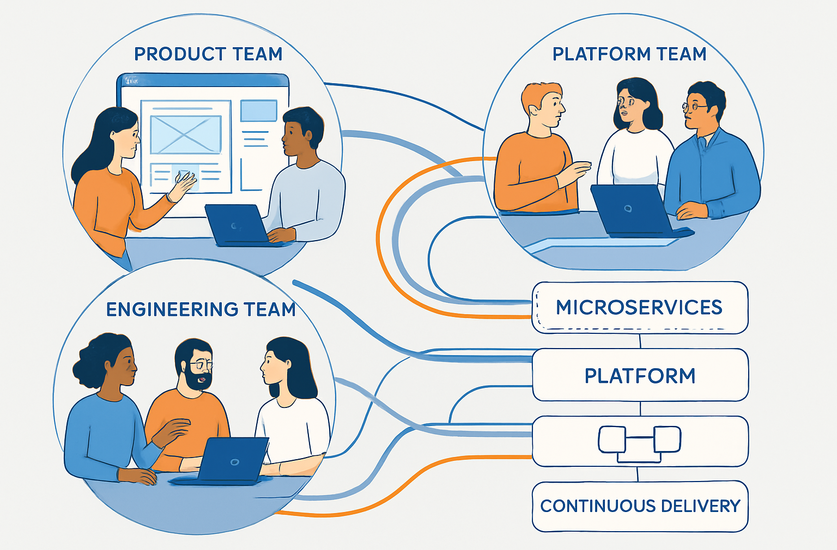
Product teams should be stable and include all necessary skills:
- Product owners who understand customer needs and business value
- Engineers (developers, automation specialists, infrastructure engineers)
- Quality and security engineers embedded from day one
- User experience designers where relevant
- Operations expertise (or platform teams that provide self-service infrastructure)
These teams stay together, building institutional knowledge and shared ownership. When Netflix restructured around product teams, they saw dramatic improvements in deployment frequency and mean time to recovery, because the people who built features also operated them.
Define Clear Product Boundaries
One common mistake is creating “product teams” that are too big or too vague. A middleware infrastructure team supporting “all integration services” isn’t a product team; it’s still a support function.
Instead, break down into specific products:
- API Gateway Product – owning rate limiting, authentication, routing
- Event Streaming Product – managing Kafka clusters, schemas, and monitoring
- Service Mesh Product – handling inter-service communication, observability, security
Each product has clear boundaries, defined customers (application teams), and measurable outcomes (API latency, event throughput, incident response times).
Shift from Resource Allocation to Value Investment
Traditional models allocate “resources” (people) to projects based on availability. Product models invest in value streams based on business priority.
This means funding shifts, too. Instead of approving individual projects, leadership funds product teams annually (or quarterly), and product owners prioritise features and improvements based on value. This mirrors how venture capitalists fund startups; betting on teams and products, not individual features.
Aligning Technology Architecture
Team structure alone won’t succeed if your technology architecture fights against product ownership.
Embrace Loosely Coupled Systems
Product teams need autonomy to move fast. That’s impossible with monolithic architectures, where every change requires coordinating with dozens of other teams.
Modern architectures use:
- Microservices or domain-driven design – allowing teams to own complete services
- API-first integration – clear contracts between products
- Event-driven patterns – reducing tight coupling and synchronous dependencies
A global retailer moved from a monolithic e-commerce platform to domain-driven microservices. Their checkout team could then deploy updates 20 times per week instead of waiting for monthly release windows that required coordinating 15 teams.
Provide Self-Service Infrastructure
Product teams can’t own outcomes if they depend on centralised ops teams for every environment, database, or deployment.
Platform engineering is the answer. Build internal platforms that let product teams self-serve:
- Infrastructure as code templates for common patterns
- CI/CD pipelines that handle build, test, security scanning, and deployment
- Observability platforms providing logs, metrics, traces, and alerts
- Service catalogues for databases, caches, and message queues
Spotify’s “golden paths” approach gives teams opinionated, pre-approved ways to build and deploy services. Teams can still customize when needed, but 80% of use cases are covered by self-service.
Bake Security and Compliance In
DevSecOps isn’t optional in product models. Security and compliance can’t be gatekeeping functions that slow teams down.
Instead:
- Automate security scanning in CI/CD pipelines
- Embed security engineers in product teams as advisors
- Provide secure-by-default templates for common patterns
- Shift left on compliance with policy-as-code
Capital One famously embedded security into product teams and automated compliance checks, reducing security review time from weeks to hours while actually improving security posture.
Measuring Success Differently
Product operating models demand different metrics:
Traditional project metrics:
- On time, on budget
- Requirements completed
- Defect counts at handover
Product operating metrics:
- Customer satisfaction (NPS, CSAT scores)
- Business outcomes (conversion rates, time-to-market, revenue impact)
- Operational excellence (availability, performance, incident response)
- Team health (deployment frequency, lead time, change failure rate)
These metrics keep teams focused on continuous value, not just initial delivery.
Practical Steps to Get Started
You don’t need to transform the entire organisation overnight. Start with pilot products:
- Choose a high-value candidate – ideally customer-facing or enabling critical business capabilities
- Form a stable, cross-functional team with clear ownership
- Define success metrics tied to business outcomes, not just technical delivery
- Invest in enablers – CI/CD, observability, self-service infrastructure
- Run for at least two quarters before judging success
- Learn and iterate – capture what worked and what didn’t
- Expand gradually based on proven patterns
One insurance company started with its claims processing product. Within six months, they reduced claim processing time by 30% and increased customer satisfaction scores by 18 points, metrics that were never even measured under the old project model.
Summary: It’s About Sustained Value
Aligning teams and technology with product operating models isn’t a restructuring exercise or a new org chart. It’s a fundamental shift in how enterprises create and sustain value.
It means betting on long-lived teams over transient projects. It means building architecture that enables autonomy instead of enforcing dependencies. It means measuring success by outcomes delivered, not tickets closed.
The organisations that master this shift aren’t just more efficient, they’re more responsive, more innovative, and better equipped to compete in markets where software is the business, not just a support function.
The question isn’t whether to adopt product operating models. It’s how quickly you can align your teams and technology to make it real.