
 Posted by
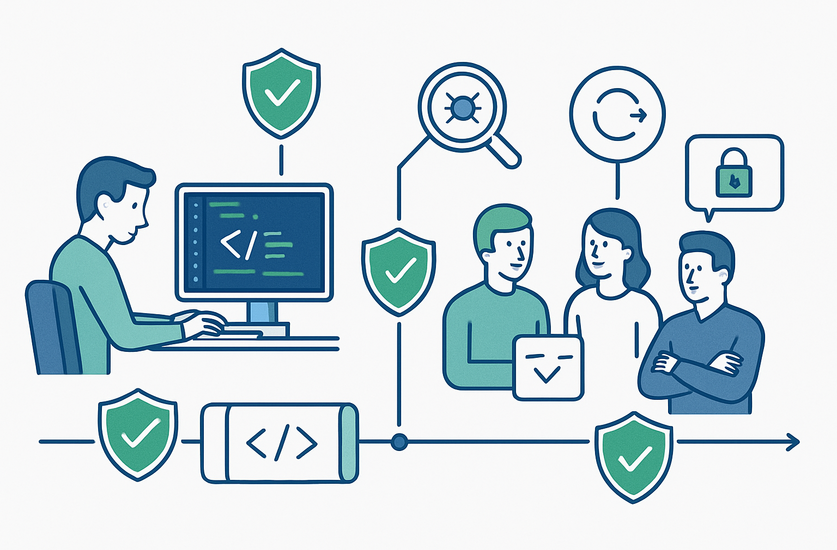
 Security vulnerabilities discovered in production cost exponentially more to fix than those caught during development. Yet, many organizations still treat security as a checkpoint at the end of the delivery pipeline; a gate that slows releases and frustrates engineers. The shift-left approach flips this model by embedding security practices early in the development lifecycle, where they’re cheaper, faster, and less disruptive to fix. But shift-left isn’t just about running scanners earlier. It’s about changing culture, tooling, and collaboration patterns to make security a shared responsibility from the first line of code.
What Shift-Left Really Means
Shift-left refers to moving security activities earlier in the software development lifecycle (SDLC), from design and coding through testing and integration. Instead of discovering vulnerabilities during a pre-production security review or worse, in production, teams identify and remediate issues when developers are still actively working on the code.
This approach reduces:
- Time to remediation: Developers fix issues while the context is fresh
- Cost: Early fixes require fewer changes across fewer systems
- Risk: Vulnerabilities never reach production environments
- Friction: Security becomes part of the workflow, not an external blocker
Shift-left doesn’t eliminate the need for later-stage security controls. Instead, it creates a layered defence that catches different issue types at the most appropriate stage.
Why Traditional Security Models Fail DevOps Teams
Traditional security models were designed for waterfall delivery, where months-long development cycles allowed time for extensive manual reviews. DevOps teams shipping multiple times per day can’t wait for weekly security meetings or manual pen-testing cycles.
Common friction points include:
- Security as a bottleneck: Centralized security teams reviewing every change create queues and delays
- Late feedback loops: Finding critical vulnerabilities days or weeks after code commits forces context-switching and rework
- False positive fatigue: Generic scanning tools that flag thousands of low-priority issues train developers to ignore security findings
- Lack of ownership: When security is “someone else’s job,” it becomes nobody’s priority
The result? Teams either slow down to accommodate security (thereby defeating DevOps benefits) or bypass security controls to maintain velocity (thereby creating risk).
Core Shift-Left Strategies That Work
1. Security in the IDE
The earliest possible intervention point is the developer’s integrated development environment (IDE). Modern tools like Snyk, SonarLint, and GitHub Copilot with security extensions provide real-time feedback as developers write code.
Real-world example: A financial services company integrated IDE-based secret scanning that alerts developers immediately when they accidentally commit API keys or passwords. Detection rates improved from 60% (caught in PR reviews) to 95% (caught before commit), and remediation time dropped from hours to minutes.
Key success factors:
- Choose tools that integrate seamlessly with popular IDEs
- Configure rules to minimize false positives initially
- Provide clear remediation guidance, not just alerts
- Make adoption voluntary at first to build trust
2. Automated Security in CI/CD Pipelines
Continuous Integration/Continuous Deployment pipelines are natural enforcement points for automated security checks. The goal isn’t to gate every deployment but to provide fast, actionable feedback.
Effective pipeline security includes:
- Static Application Security Testing (SAST): Analyzes source code for vulnerabilities
- Software Composition Analysis (SCA): Identifies vulnerable dependencies and licensing issues
- Container scanning: Checks base images and layers for known vulnerabilities
- Infrastructure as Code (IaC) scanning: Validates Terraform, CloudFormation, or Kubernetes configs against security baselines
Real-world example: An e-commerce platform implemented parallel security scans in its CI pipeline that run alongside unit tests. Critical vulnerabilities fail the build, high-severity issues create tickets automatically, and medium/low findings generate reports without blocking deployment. This balanced approach maintained deployment velocity while catching 89% of security issues before production.
3. Security Champions Program
Shift-left requires distributed security knowledge. Security champions are developers who receive additional security training and act as liaisons between engineering teams and central security functions.
Program components:
- Monthly security training and knowledge sharing
- Early access to new security tools and policies
- Dedicated time allocation (typically 10-20% of capacity)
- Recognition and career development opportunities
Real-world example: A healthcare technology company trained two security champions per product team. These champions helped tune security scanning rules to their codebases, reducing false positives by 70% and improving developer trust in security tooling. They also served as the first point of contact for security questions, deflecting routine queries from the central security team.
4. Threat Modelling in Design
The absolute earliest shift-left activity is threat modelling during design phases. Before writing code, teams identify potential security risks in architecture, data flows, and trust boundaries.
Lightweight threat modelling approaches:
- STRIDE framework: Identify Spoofing, Tampering, Repudiation, Information Disclosure, Denial of Service, and Elevation of Privilege threats
- Attack trees: Map potential attack vectors and mitigations
- Data flow diagrams: Visualize where sensitive data moves and where controls are needed
Real-world example: A SaaS provider introduced 30-minute threat modelling sessions at the start of each feature sprint. Using simple whiteboard diagrams and a STRIDE checklist, teams identified an average of 3-4 security considerations per feature that would have been expensive to retrofit later. This investment prevented an estimated 40% of security-related rework.
5. Security-Focused Peer Reviews
Code reviews are already standard practice in most DevOps environments. Adding security-focused review criteria turns them into powerful shift-left mechanisms.
Security review checklist items:
- Authentication and authorization checks
- Input validation and sanitization
- Sensitive data handling (encryption, masking, retention)
- Error handling that doesn’t leak information
- Dependency updates and known vulnerabilities
Making Shift-Left Sustainable
Shift-left initiatives fail when they add friction without demonstrating value. Sustainable approaches share common characteristics:
Start with high-impact, low-friction wins: Implement secret scanning or dependency checking before more complex SAST tools. Early successes build momentum.
Tune aggressively: Out-of-the-box security tools generate overwhelming noise. Invest time upfront to tune rules for your tech stack, risk appetite, and coding patterns.
Measure outcomes, not activity: Track metrics like mean-time-to-remediation, vulnerabilities reaching production, and developer satisfaction, not just scan counts or findings volume.
Integrate with existing workflows: Security tools should fit into existing CI/CD pipelines, ticket systems, and communication channels. Don’t force developers to learn new interfaces.
Celebrate and reward: Recognize teams that improve security metrics. Share success stories. Make security expertise a visible career advantage.
Common Pitfalls to Avoid
Tool overload: Deploying five security scanning tools simultaneously overwhelms teams and guarantees poor adoption. Phase rollouts and consolidate where possible.
All-or-nothing policies: Treating every finding as build-breaking creates workarounds and shadow IT. Use risk-based policies that distinguish critical issues from minor improvements.
Neglecting security team capacity: Shift-left distributes security work, but doesn’t eliminate the need for specialized expertise. Central security teams need time to train champions, tune tools, and handle escalations.
Ignoring developer feedback: If security tools are painful to use or generate meaningless alerts, developers will find ways around them. Regular feedback loops are essential.
The Business Case for Shift-Left
Shift-left security delivers measurable business value:
- Reduced remediation costs: Industry data suggests fixing vulnerabilities in production costs 30x more than fixing them during development
- Faster time to market: Catching issues early prevents late-stage delays and emergency patches
- Improved compliance posture: Continuous security validation supports audit requirements more effectively than point-in-time assessments
- Lower breach risk: Fewer vulnerabilities reaching production directly reduces attack surface and potential breach costs
Takeaway
Shift-left security isn’t a single tool or practice; it’s a philosophy of building security into every stage of the development lifecycle. Success requires the right combination of tooling, culture, and process changes that make security fast, relevant, and developer-friendly. Start with high-impact practices like IDE security plugins and automated pipeline scanning, build security expertise through champions programs, and continuously tune based on feedback and metrics. When done right, shift-left doesn’t slow DevOps down; it enables teams to move faster with confidence that security is built in, not bolted on.
The teams winning at shift-left security aren’t the ones with the most tools. They’re the ones who’ve made security a natural part of how they build software every day.
See also how to integrate security into DevOps pipelines and how automated compliance checks support continuous confidence.
Frequently Asked Questions
What does shift-left security mean?
It means moving security checks and guidance earlier into planning, coding, build, and deployment workflows.
What is a practical first step?
Start with a low-friction control such as secret scanning or dependency checks, then tune it with developer feedback.