
 Posted by
 Every DevOps team has heard the promise: ship faster, fail faster, learn faster. But there’s a problem. Security teams often feel like they’re being asked to approve a rocket launch in 30 seconds. Meanwhile, engineering teams see security as the department of “no”; the final gate that turns a two-week sprint into a two-month slog.
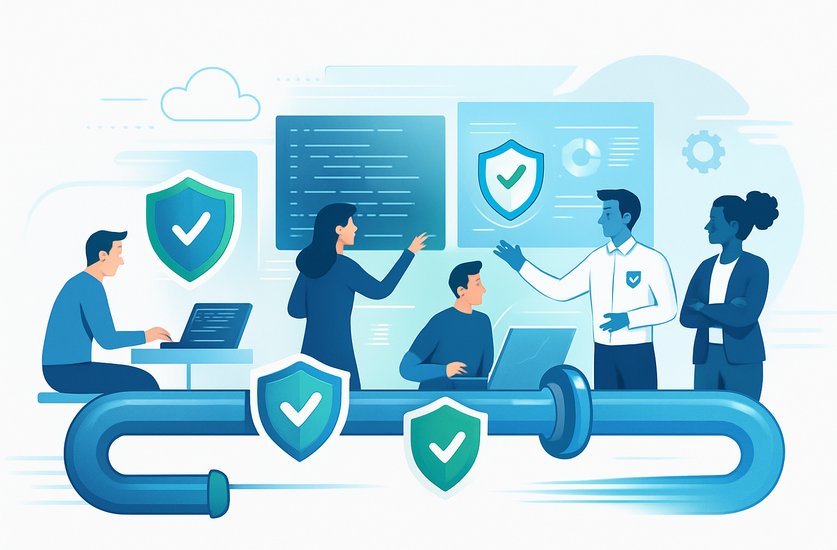
The truth? Security doesn’t have to slow you down. When integrated properly into DevOps pipelines, security becomes an accelerator, not a brake. The key is shifting from security as a gate to security as code, embedded into every stage of your delivery process. Let’s explore how to make that shift real.
Why Security Often Becomes a Bottleneck
Before diving into solutions, it’s worth understanding why security traditionally slows things down:
- Late-stage reviews: Security assessments happen at the end, when findings are expensive and disruptive to fix
- Manual processes: Spreadsheets, email approvals, and manual scans don’t scale with daily or hourly deployments
- Disconnect between teams: Security speaks risk, engineering speaks velocity; without a shared language or tooling, friction is inevitable
- Lack of visibility: Security teams can’t protect what they can’t see, and manual discovery doesn’t keep pace with cloud-native environments
The answer isn’t to skip security. It’s to weave it into the pipeline so deeply that it becomes invisible; present, but not obstructive.
The Core Principles of Pipeline-Integrated Security
1. Shift Left, But Don’t Forget Right
“Shift left” has become a mantra, and for good reason. Catching vulnerabilities early, during code commit or build, is cheaper and faster than finding them in production. But shifting left doesn’t mean ignoring runtime.
A balanced approach includes:
- Static Application Security Testing (SAST) during code commits to catch common vulnerabilities like SQL injection or hardcoded secrets
- Software Composition Analysis (SCA) during builds to flag vulnerable dependencies
- Dynamic Application Security Testing (DAST) in staging to test running applications
- Runtime protection and monitoring in production to catch what slipped through
2. Automate Everything, Fail Fast
Manual security reviews don’t scale. Automation does. Every pipeline stage should include automated security checks that:
- Run automatically on every commit or pull request
- Provide fast, actionable feedback (ideally within minutes)
- Fail builds for critical issues, warn for moderate ones
- Integrate seamlessly with existing CI/CD tools like Jenkins, GitLab CI, or GitHub Actions
For example, a financial services company integrated secret scanning into their GitHub pull requests. Within weeks, they caught over 200 potential leaks; credentials that would have gone straight to production. The check added less than 10 seconds to each build.
3. Policy as Code
Security policies shouldn’t live in 50-page PDFs. They should live in code, versioned in Git, and enforced automatically.
Tools like Open Policy Agent (OPA) or HashiCorp Sentinel let you define rules like:
- “No container can run as root”
- “All S3 buckets must have encryption enabled”
- “Database credentials must come from a vault, not environment variables”
These policies run as part of infrastructure-as-code pipelines, catching misconfigurations before they reach cloud environments. Developers get immediate feedback, security gets consistent enforcement, and nobody waits for a ticket response.
4. Developer-Friendly Tooling
If security tools are clunky, developers will route around them. Integration means meeting developers where they already work:
- IDE plugins that highlight vulnerabilities as code is written
- Slack or Teams notifications instead of buried reports
- Clear, prioritized findings with fix guidance, not just CVE numbers
- Dashboards that show trends and improvements, not just failures
When Netflix built its security tooling, they focused obsessively on developer experience. Their tools provided context-aware recommendations and auto-remediation options. Adoption skyrocketed because it made developers’ lives easier, not harder.
Practical Steps to Integrate Security into Your Pipeline
Step 1: Start with the Low-Hanging Fruit
Don’t try to boil the ocean. Begin with:
- Secret scanning: Tools like GitGuardian or GitHub Advanced Security catch exposed credentials
- Dependency scanning: Services like Snyk or Dependabot flag vulnerable libraries
- Container scanning: Integrate Trivy or Aqua Security into your Docker builds
These provide immediate value with minimal friction.
Step 2: Build Security Champions Within Teams
You don’t need every developer to become a security expert, but having security-minded engineers embedded in product teams bridges the gap. They:
- Advocate for secure coding practices
- Help interpret security findings
- Provide feedback to central security teams on what’s working and what’s not
Google’s engineering culture encourages this model, with security engineers embedded across product teams rather than isolated in a separate org.
Step 3: Define and Enforce Quality Gates
Not all vulnerabilities are created equal. Define clear thresholds:
- Critical/High: Block deployment, require immediate fix
- Medium: Allow deployment but create a backlog item with SLA
- Low/Info: Track, but don’t block
This prevents teams from drowning in noise while ensuring real risks are addressed.
Step 4: Measure What Matters
Track metrics that drive behavior:
- Mean time to remediate vulnerabilities (MTTR)
- Percentage of builds passing security checks on first run
- Number of vulnerabilities caught per pipeline stage
- Security debt over time
Avoid vanity metrics like “total scans run”; focus on outcomes, not activity.
Real-World Example: E-Commerce Platform Transformation
Consider a European e-commerce company facing pressure to release features weekly while maintaining PCI-DSS compliance. Their original process involved a two-week security review before any production release.
They transformed their approach by:
- Integrating SAST and SCA tools into their Jenkins pipelines, catching 80% of issues before code review
- Implementing automated policy checks for infrastructure-as-code using OPA
- Creating a security dashboard showing real-time compliance status
- Training developers on common vulnerability patterns through monthly workshops
Result? Release cycles dropped from three weeks to five days, while security findings in production decreased by 60%. Security became a competitive advantage, not a constraint.
Common Pitfalls to Avoid
- Tool overload: Don’t integrate 15 different security tools. Choose 3-5 that cover your key risks and integrate well
- Alert fatigue: Too many low-priority alerts train teams to ignore everything. Tune thresholds carefully
- Blaming developers: Security issues aren’t moral failures. Focus on systemic improvements, not individual fault
- Set-and-forget: Threat landscapes evolve. Review and update your security pipeline quarterly
The Path Forward
Integrating security into DevOps pipelines isn’t a one-time project; it’s a mindset shift. Security becomes everyone’s responsibility, automated where possible, and visible throughout the delivery lifecycle.
The teams that get this right don’t choose between speed and security. They achieve both. They ship confidently, knowing that security is baked in, not bolted on.
Start small. Automate incrementally. Measure outcomes. And remember: the goal isn’t perfect security (which doesn’t exist); it’s sustainable, scalable security that enables the business to move fast without breaking things.
Key Takeaways
- Security as code: Automate checks and policies directly into CI/CD pipelines
- Shift everywhere: Cover the full lifecycle from code commit to production runtime
- Developer experience matters: If tools are painful, they’ll be bypassed
- Start small, scale smart: Begin with high-impact, low-friction integrations
- Measure outcomes, not activity: Focus on remediation speed and vulnerability reduction
When security and DevOps teams align on tools, processes, and goals, delivery accelerates and risk decreases. That’s not a trade-off; that’s transformation.
For related controls, read about shift-left security strategies and automated IT compliance checks.
Frequently Asked Questions
How can security be integrated into a DevOps pipeline?
Automate relevant checks across code, build, test, deployment, and runtime stages, with actionable feedback for engineers.
Which controls should come first?
Start with high-value, low-friction controls such as secret, dependency, and container scanning, then add policy checks.