
 Posted by
 Introduction
At 3 AM, a critical service goes down. Tickets flood in from multiple channels. Your on-call engineer wakes up to 47 alerts, half of them duplicates, and spends precious minutes just figuring out what’s actually broken. Sound familiar?
This scenario plays out in IT organizations every day. Traditional ITSM tools have served us well for decades, but they were built for a different era; one with fewer services, slower release cycles, and simpler architectures. Today’s distributed systems, microservices, and cloud-native applications generate incident volumes and complexity that human-only processes simply can’t handle efficiently.
AI-powered ITSM tools aren’t just a nice-to-have anymore. They’re becoming essential for teams that want to maintain reliability without burning out their engineers. Let’s explore how AI is transforming incident management from a reactive scramble into a streamlined, intelligent process.
The Incident Management Problem in Modern IT
Before diving into solutions, let’s acknowledge what’s changed:
Volume and Velocity: Organizations running cloud-native infrastructure can generate thousands of alerts daily. A single incident might trigger dozens of monitoring alerts across different systems.
Complexity: Modern applications span multiple cloud providers, on-premises systems, third-party APIs, and edge locations. Understanding the blast radius of an incident requires connecting dots across numerous data sources.
Alert Fatigue: When everything generates an alert, nothing is truly urgent. Teams become desensitized, and critical issues get lost in the noise.
Context Switching: Engineers spend more time gathering information, correlating events, and updating tickets than actually fixing problems.
These challenges don’t just slow down resolution; they burn out teams and erode service reliability.
How AI Changes the Game
AI-powered ITSM tools tackle these challenges through several key capabilities:
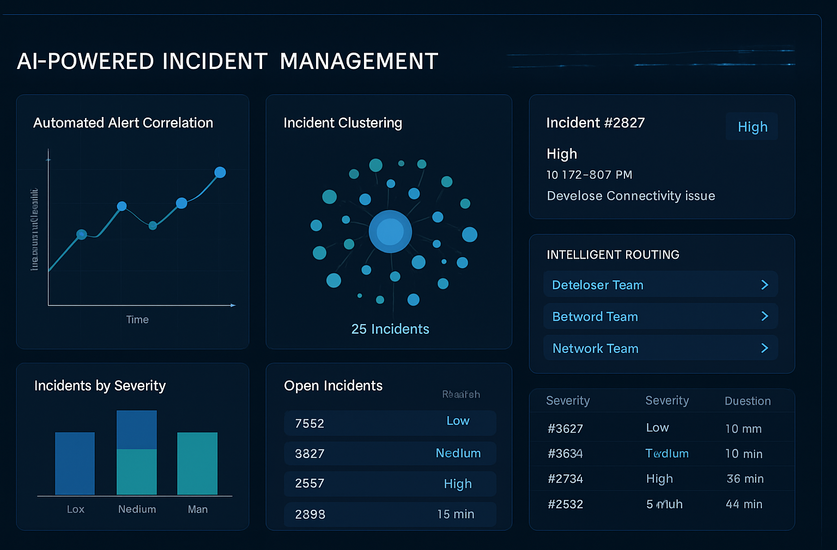
Intelligent Alert Correlation and Deduplication
Instead of creating separate tickets for 30 alerts about the same underlying issue, AI algorithms can:
- Recognize patterns across multiple alert sources
- Group related incidents automatically
- Identify the probable root cause from correlated events
- Suppress noise while escalating genuine issues
Real-world example: A major European bank implemented AI-driven correlation and reduced their incident ticket volume by 68%. What previously appeared as dozens of separate issues was often a single root cause with multiple symptoms. Engineers could focus on fixing the actual problem instead of triaging duplicates.
Automated Categorization and Routing
AI models trained on historical ticket data can:
- Automatically categorize incidents with high accuracy
- Route tickets to the right team based on context, not just keywords
- Assign priority based on actual business impact, not just user-reported severity
- Identify VIP users or critical services automatically
This eliminates the bottleneck of manual triage and gets the right expert involved immediately.
Predictive Resolution Suggestions
Perhaps the most powerful capability: AI can suggest solutions before humans even start investigating.
By analyzing thousands of previous incidents, AI can:
- Recommend specific troubleshooting steps
- Surface relevant knowledge base articles
- Suggest similar past incidents and their resolutions
- Even auto-remediate common issues without human intervention
Real-world example: Spotify’s engineering team uses machine learning to automatically suggest fixes for common incidents. For certain categories of problems, their system can propose the exact command or configuration change needed, complete with links to the relevant runbook section. This has cut mean time to resolution (MTTR) by 40% for frequent issue types.
Natural Language Processing for Faster Logging
Nobody enjoys filling out incident forms during an outage. AI-powered NLP allows:
- Voice-to-text incident reporting
- Automatic extraction of key details from free-form descriptions
- Intelligent field population based on context
- Chat-based incident creation via Slack or Teams
Engineers can report issues conversationally, and the system handles the bureaucracy.
Practical Implementation Guidelines
If you’re considering AI-powered ITSM tools, here’s how to approach it:
Start with Data Quality
AI is only as good as the data it learns from. Before implementing:
- Clean up your existing incident database
- Standardize categorization and tagging
- Ensure resolution notes are meaningful, not just “fixed”
- Establish data governance for ongoing quality
Begin with High-Volume, Low-Complexity Incidents
Don’t try to automate everything at once. Focus on:
- Password resets and access requests
- Common application errors with known fixes
- Infrastructure alerts with standard responses
- Duplicate detection and correlation
These areas offer quick wins and build confidence in AI capabilities.
Keep Humans in the Loop
AI should augment, not replace, your engineers:
- Use AI for suggestions, not autonomous actions (initially)
- Require human approval for critical or unfamiliar scenarios
- Create feedback loops so engineers can correct AI mistakes
- Monitor AI decisions and continuously refine models
Measure What Matters
Track metrics that reflect real improvement:
- MTTR reduction: How much faster are incidents resolved?
- Ticket deflection rate: How many incidents are auto-resolved?
- Routing accuracy: Are tickets reaching the right team first time?
- Alert noise reduction: What percentage of alerts are now suppressed as duplicates?
- Engineer satisfaction: Are your teams less burned out?
Choose the Right Tool for Your Maturity
Not all organizations need the most sophisticated AI:
- Emerging ITSM maturity: Focus on basic automation and categorization
- Developing maturity: Add intelligent routing and correlation
- Advanced maturity: Implement predictive analytics and auto-remediation
Tools like ServiceNow with AI Ops, BMC Helix with AIOps, or PagerDuty with Event Intelligence offer different levels of sophistication.
Common Pitfalls to Avoid
Over-automation too quickly: Start conservatively. An AI that auto-closes tickets incorrectly will lose team trust fast.
Ignoring change management: Your teams need training and time to adapt. Involve them early and often.
Black box syndrome: Choose tools that explain their reasoning. “The AI said so” isn’t acceptable when services are down.
Neglecting feedback loops: AI models degrade without continuous learning. Build processes to retrain on new data.
The Future: Beyond Reactive Incident Management
The next evolution isn’t just faster incident response; it’s preventing incidents altogether:
- Anomaly detection: AI spots unusual patterns before they become outages
- Predictive maintenance: Systems that know when components will fail
- Autonomous remediation: Self-healing infrastructure that fixes issues without human intervention
- Continuous learning: Systems that get smarter with every incident
We’re moving from “how quickly can we respond?” to “how can we prevent this from happening?”
Key Takeaways
AI-powered ITSM tools are transforming incident management from a manual, reactive process into an intelligent, proactive discipline. The benefits are real:
- Reduced incident volume through intelligent correlation
- Faster resolution via automated routing and suggested fixes
- Lower engineer burnout by eliminating toil
- Better service reliability through pattern recognition
But success requires thoughtful implementation: clean data, gradual rollout, human oversight, and continuous improvement. Start small, measure results, and scale what works.
The organizations winning at incident management aren’t necessarily those with the most sophisticated AI. They’re the ones who’ve thoughtfully integrated AI capabilities into their workflows, kept their teams engaged, and maintained focus on what matters: keeping services running and engineers sane.
The question isn’t whether to adopt AI-powered ITSM; it’s how quickly you can do it effectively.